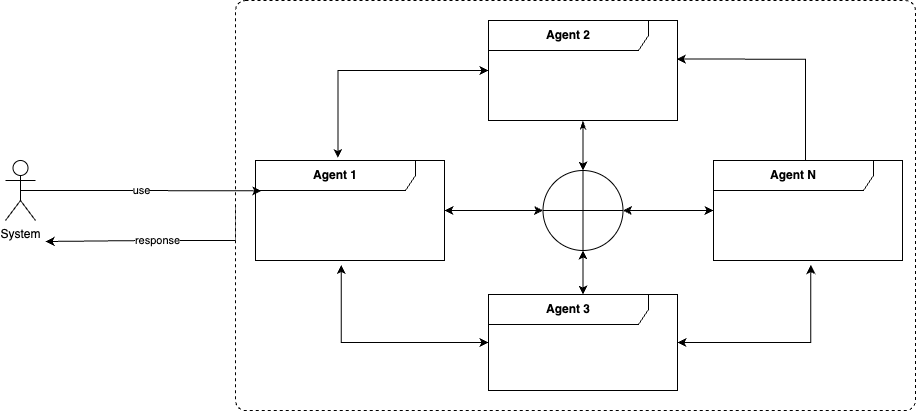
In an era of escalating interconnectivity and system complexity, the necessity for systems capable of operating autonomously and efficiently has become paramount. Agent-based architectures have emerged as an innovative paradigm to address this demand, enabling systems not only to execute specific tasks but also to perceive their environment and make informed decisions autonomously.
An agent is an autonomous software component that may leverage AI capabilities to perceive its environment, plan, and execute tasks with minimal human intervention. It is characterized by its ability to break down a general objective into manageable subtasks, make decisions based on that perception (with or without AI), and coordinate the execution of these tasks to achieve predefined goals within a specific environment.
Table of contents
Open Table of contents
Key characteristics of a software component agent
-
Autonomy: an agent can operate without direct intervention from users or other systems. It makes decisions on its own based on its state and perceptions of the environment.
-
Reactivity: agents perceive their environment (through virtual sensors or data access) and respond to changes occurring within it.
-
Proactivity: in addition to reacting to external stimuli, an agent has its own goals and can plan and execute actions to proactively achieve them.
-
Communication capability: agents interact with other agents or systems through some form of communication, such as message exchange, enabling coordination and collaboration.
Anatomy of a agent
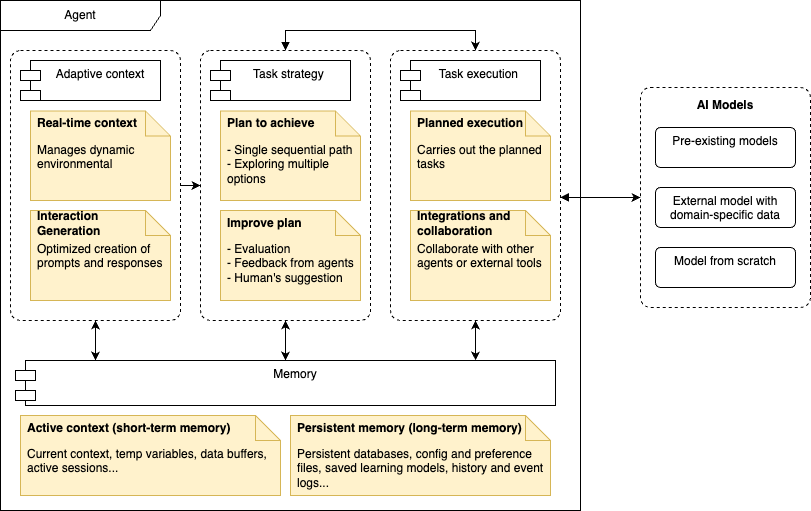
An agent can be broken down into several key components:
Adaptive context management
Agent’s ability to adapt to real-time context, managing relevant information to achieve the user’s objectives. How the agent structures and manages dynamic environmental information to understand the user’s goals. Intelligent interaction generation to focus on the optimized creation of prompts and responses for effective and accurate interaction between the agent and the user.
Memory
-
Active Context (short-term memory): this memory holds the relevant information for the current context in which the agent is operating. For example, the latest version of GPT-4 has a maximum limit of 128k tokens, equivalent to approximately 300 pages of text.
-
Persistent Memory (long-term memory): this memory stores information durably for future processes and decisions.
Task strategy manager
Describes how an agent creates a plan to achieve the user’s goals. It can do this in two ways: by following a single sequential path or by exploring multiple options at each step. The agent can also improve the plan by adjusting it based on its own evaluation, feedback from other agents, or suggestions from humans
Task execution manager
Describes how the agent moves from planning to action, ensuring task execution and monitoring. The agent carries out the planned tasks and can use its own knowledge or external tools to complete them. The agent can collaborate with other agents or external tools to complete complex tasks.
AI models integration
Covers options for choosing and adapting AI models based on the agent’s needs.
- Use pre-existing models, which are cost-effective and generalize well. These models can be fine-tuned for specific tasks
- Adjust an external model’s parameters with domain-specific data to improve performance on specialized tasks.
- Build and train a model from scratch, giving more control and security, but at a higher cost and resource requirement.
Patterns to design autonomous agents
Some patterns and approaches that facilitate the development of agents capable of operating efficiently in changing environments.
LLM exclusive
This pattern suggests that only a language model (LLM) is used to perform specific tasks. In this approach, the model is responsible for all actions, decisions, and reasoning without the intervention of other components or tools.
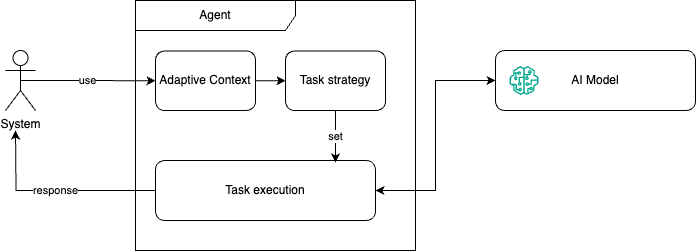
Reflection
Reflection is a formalized optimization process to iteratively review and refine the agent-generated responses. The user provides specific goals to the agent, which then generates a plan to meet the user’s requirements. Subsequently, the user can instruct the agent to reflect on the plan and the corresponding reasoning process.
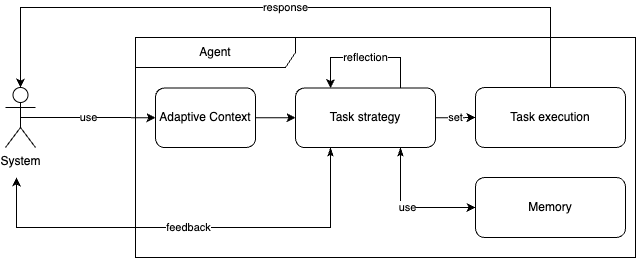
External tool integration:
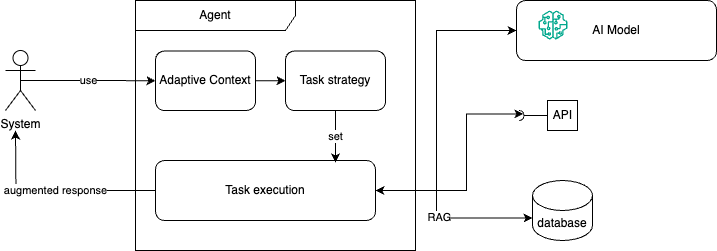
The architecture does not rely solely on the language model but also utilizes external tools (such as databases, APIs, browsers, etc.) to gather additional information or execute more specific actions that the model alone cannot perform efficiently.
Long-Term planning
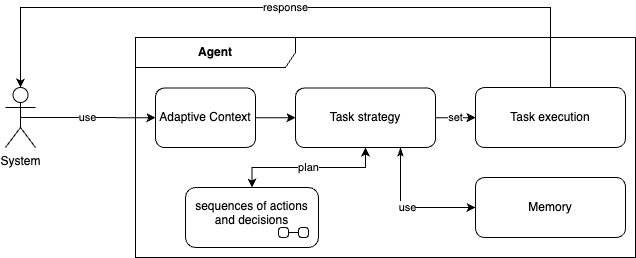
This pattern involves the architecture having the capacity to plan in the long term or structure sequences of actions before executing them. Planning is essential for problems that require multiple steps or interdependent decisions.
Multi-Agent collaboration
The architecture includes multiple agents interacting with one another. Each agent can have different roles or specializations, and they collaborate or compete to achieve a common goal. This pattern is used for more complex systems that require division of labor or solving tasks from different perspectives.